Mapping the wetland inundation dynamics of Lake Chilwa’s recession and refilling cycles using multisource remote sensing data
Integrating optical-radar time-series data with participatory mapping of migrant fishing communities

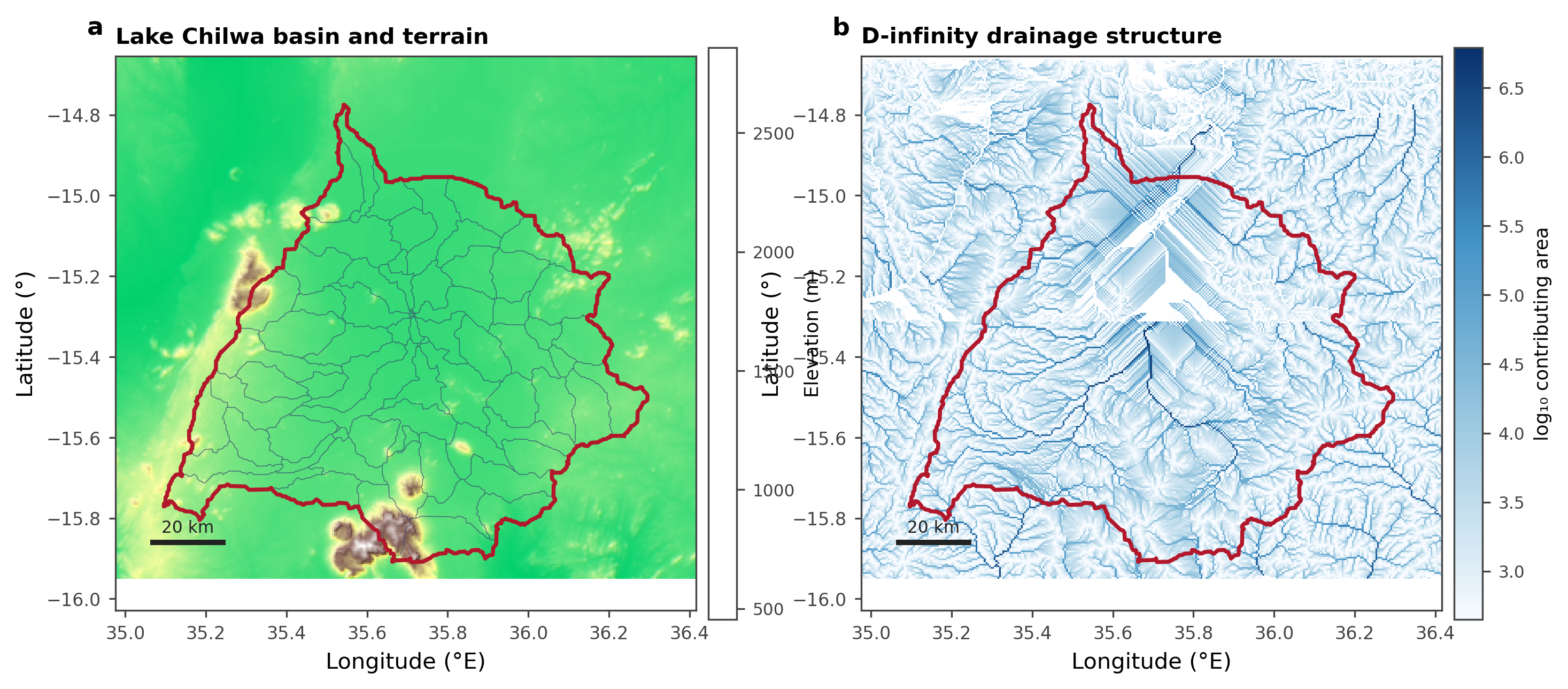
Wetlands rank among the most valuable ecosystems on Earth and the hardest to monitor, nowhere more so than in sub-Saharan Africa. The binding constraint is the detection of water standing beneath emergent vegetation: optical sensors cannot resolve it in principle, C-band radar resolves it only conditionally, and the state of the art commonly answers by excluding the class. Because vegetated water can constitute most of a wetland’s inundated area, omitting it misstates extent, hydroperiod, and flood timing. We take that problem as our primary objective in the Lake Chilwa basin, a shallow endorheic lake in southern Malawi that recedes and refills on a cycle of roughly fifteen years and whose migratory fishery tracks the water. We build one model from four components: a harmonised Landsat record spanning 1984 to 2024 with five spectral water indices; Sentinel-1 C-band and ALOS PALSAR L-band backscatter; sub-pixel cover fractions fitted by spectral endmember mixture analysis; and training labels from participatory mapping with fishing communities, who observe water beneath the vegetation directly. Within the self-derived 8,752 km² basin, sub-pixel open water averaged 1,225 km², peaking at 2,083 km² in 2024 and falling to 835 km² in the 1995 recession, two fifths of peak extent. Open water and emergent vegetation are anti-correlated, so the wetland compensates as the lake retreats and the combined footprint, 2,807 km² at the 2023 refill, varies far less than open water alone. Mapping the footprint rather than the lake changes how recession reads hydrologically, and the fieldwork records the migration and enforcement patterns satellites cannot.
About this book
Every page here is generated from the master manuscript at 01.manuscript/Manuscript_2026-08-03.qmd by 05.scripts/split_manuscript.R. Edit the master, never these pages.